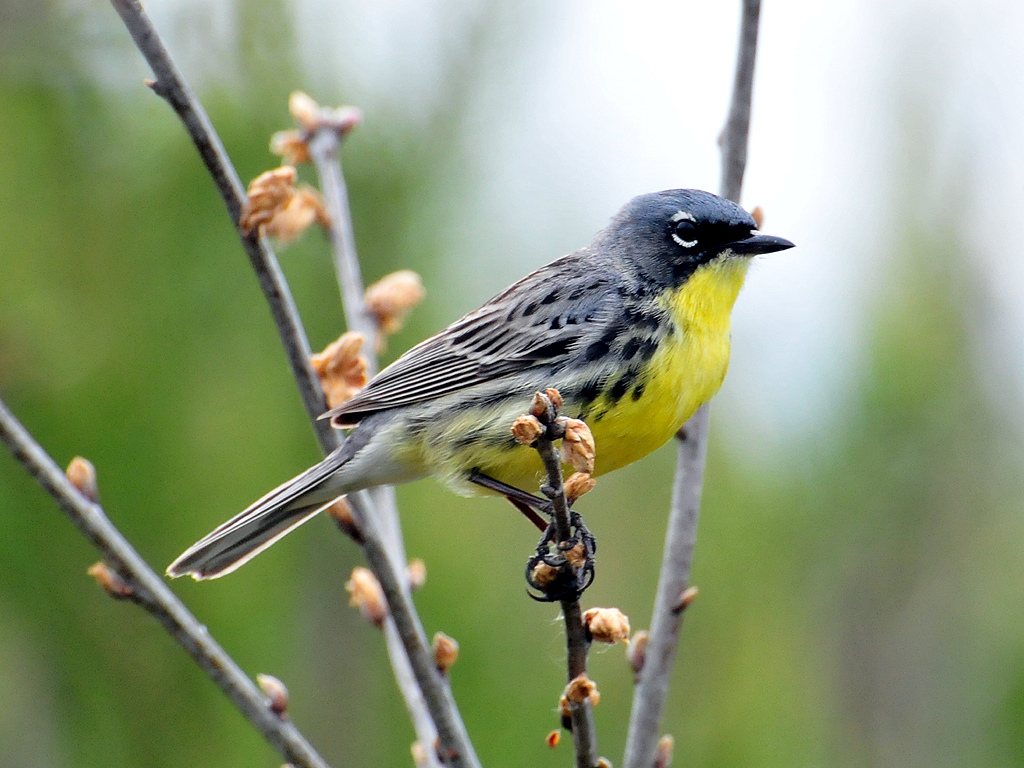
If you had told a birder in 1987 that the Kirtland's Warbler would one day be taken off the endangered species list, they probably would have laughed — or cried. Back then, there were only 167 breeding pairs left on Earth. Total. Worldwide. You could have fit every surviving Kirtland's Warbler into a modest-sized auditorium and still had seats to spare.
Today? The story looks a whole lot different. In 2019, this little songbird became the first warbler ever removed from the Endangered Species List — not because it vanished, but because people refused to let it. The population rebounded to over 2,300 breeding pairs at its peak. And while recent surveys show numbers dipping again (down to about 1,489 pairs in 2025), the conservation community is confident the bird will pull through. Why? Because we finally understand what it needs.
The Pickiest Bird in North America
Kirtland's Warblers are not what you would call flexible. They nest exclusively in young jack pine forests between six and twenty years old, in northern Michigan, Wisconsin, and Ontario. That is it. No oak trees. No suburban parks. No “close enough” habitats. Just dense, scrubby jack pine with plenty of low branches and soft ground cover for their nests.
Historically, wildfires swept through the Great Lakes region every few decades, clearing old forest and creating fresh stands of young jack pine exactly the way this warbler liked it. But once fire suppression became standard practice, the habitat pipeline dried up. Without human intervention, the Kirtland's Warbler was headed for extinction simply because the forest had grown up around it.
Planting a Million Trees a Year
The fix turned out to be surprisingly straightforward: plant jack pines. Lots of them. Conservation teams — led by the Michigan DNR, the U.S. Fish and Wildlife Service, and partners like the Arbor Day Foundation and American Forests — began manually recreating the habitat that wildfires used to provide.
The results speak for themselves. Since 2018, the Arbor Day Foundation alone has helped plant over 33 million trees in Michigan. About 1.5 million jack pine seedlings go into the ground every year, arranged in what foresters call “opposing wave” patterns that mimic natural fire clearings. It is the largest ongoing tree-planting effort for a single bird species in North America — and possibly the world.
“This bird taught us something important: conservation isn't just about protecting what exists. Sometimes it's about building the future one seedling at a time.”— Dr. Samuel Henderson, Avian Society Field Biologist
A Speed Bump, Not a Dead End
The 2025 census was a bit of a gut check. The population dropped by roughly 750 breeding pairs from its 2021 peak. But here is the thing: everyone saw it coming. Decades of tree planting created a wave of perfect habitat that peaked around 2020 — and now much of it has aged past the warbler's narrow window. The stands are 30 to 40 years old now, which is great if you are a lumber company, but useless if you are a Kirtland's Warbler looking for a nest site.
The good news? A new 10-year conservation plan is already underway. Forestry teams are now selectively harvesting mature stands to jumpstart the next wave of young habitat. Prescribed burns are being evaluated as a lower-cost alternative to planting. And a particularly unfortunate 2023 hailstorm that wiped out half a nursery's seedlings? That is just a reminder that conservation is never truly “done.”
There is also the matter of the brown-headed cowbird, a brood parasite that once posed a serious threat by laying eggs in warbler nests. Cowbird trapping was a major part of early recovery efforts. These days, parasitism rates have dropped below 1%, so trapping has been greatly reduced — one more sign that the ecosystem is finding its balance.
Go See One For Yourself
Here is my honest advice: if you have never seen a Kirtland's Warbler, put it on your list. They are not flashy — a small, blue-gray bird with a yellow belly and a broken white eye ring — but hearing one sing from the top of a jack pine on a quiet May morning is one of those birding experiences that stays with you. They are still found in the same core areas of northern Michigan near Mio and Grayling, and Wisconsin now hosts a small but growing population as well.
More importantly, every time you see one, you are looking at proof that conservation works. In a world full of bad news about biodiversity loss, the Kirtland's Warbler is a bright yellow reminder that we can bring species back from the brink if we are willing to do the work.
The Kirtland's Warbler is what conservationists call a “conservation-reliant” species — it will always need our help. But after watching this bird come back from the edge of oblivion, I think that is a pretty good deal. Some partnerships are worth keeping.